Most answers to this question give one number, usually 3,000 lumens. That number is too high for a modest screen after dark and far too low for any screen in daylight. The brightness you need depends on two things: how large the picture is and how dark it is when you press play.
This guide shows how to work out the number for your own setup. It uses the same screen brightness targets the cinema industry uses, and it explains why no consumer projector can compete with the sun.
The Short Answer
- After dark, on a 100 to 120-inch screen: about 500 to 700 lumens reaches cinema-level brightness. Because real output is usually below the rated figure, look for roughly double that in ANSI or ISO lumens.
- After dark, on a 150-inch screen: about 1,100 lumens reaches the same level. A 200-inch screen needs about 1,900.
- Starting at sunset, or with porch and street lights nearby: plan for three times as much light as the after-dark figures. On a 120-inch screen that is more than 2,000 lumens.
- In daylight: no home projector is bright enough. Daylight puts many times more light on the screen than the projector does. Wait for dusk, move into deep shade, or use a TV made for outdoor use.
- Only compare ANSI lumens or ISO lumens. Other “lumens” on a product page are not measured the same way and can be several times higher.
A Safety Note Before You Set Up
Projectors are indoor electronics. Keep the projector, power strip, and every plug connection dry, and bring the equipment inside after the movie. If you run an extension cord across the yard, the Electrical Safety Foundation International advises using only cords marked for outdoor use and checking them for damage first. Plug into an outlet protected by a ground-fault circuit interrupter (GFCI), and route the cord where nobody will trip over it in the dark.
Why Screen Size Changes the Answer
A projector’s lumen rating describes how much light leaves the lens in total. It does not tell you how bright the picture looks. The same light spread over a larger screen gives a dimmer image.
Picture brightness is measured in foot-lamberts. ProjectorCentral gives the formula for working backward from a target brightness to the lumens you need:
Lumens = foot-lamberts × screen area in square feet ÷ screen gain
Screen gain describes how much light the screen reflects toward the audience. A plain matte white screen has a gain of about 1.0, which is what the tables below assume.
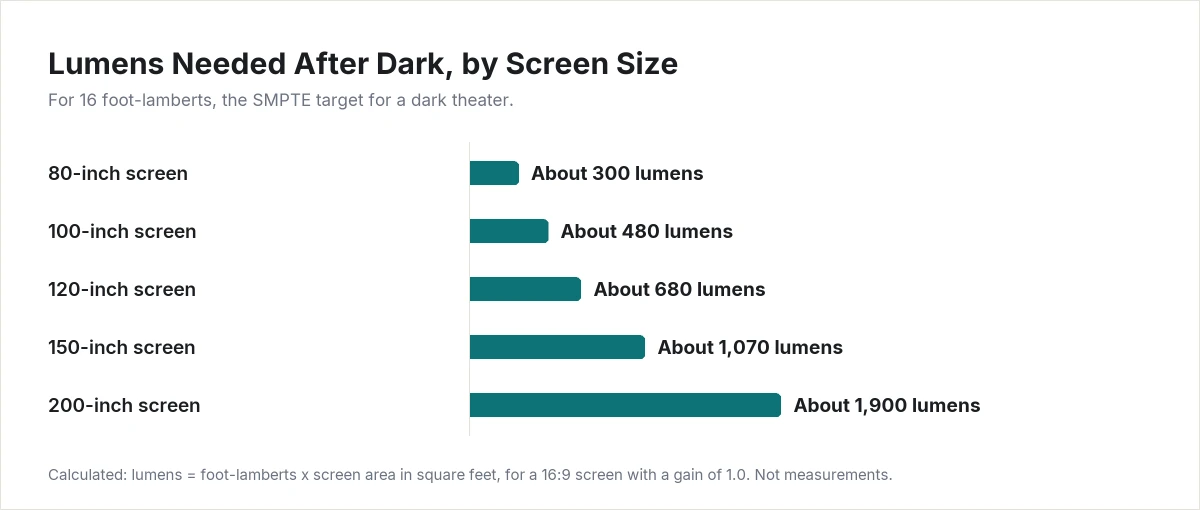
For a target, the Society of Motion Picture and Television Engineers (SMPTE) recommends 16 foot-lamberts for a dark theater, with an acceptable range of 12 to 22. A backyard well after sunset, away from lights, is close to a dark theater, so 16 foot-lamberts is a sensible goal.
Lumens Needed After Dark, by Screen Size
| Screen size (16:9) | Screen area | Lumens for 16 foot-lamberts |
|---|---|---|
| 80 inches | 19.0 sq ft | About 300 |
| 100 inches | 29.7 sq ft | About 480 |
| 120 inches | 42.7 sq ft | About 680 |
| 150 inches | 66.8 sq ft | About 1,070 |
| 200 inches | 118.7 sq ft | About 1,900 |
Figures are calculated from the formula above for a screen with a gain of 1.0. They are not measurements.
Two things follow from this table.
Doubling the screen size takes four times the light. A 200-inch screen has four times the area of a 100-inch screen, so it needs four times the lumens for the same brightness. If your projector is modest, a smaller picture will look better than a larger, dimmer one.
Small portable projectors are fine after dark at modest sizes. A projector that truly delivers 500 lumens can light a 100-inch screen to cinema brightness once the sky is dark. The same projector on a 150-inch screen reaches less than half of that level.
What Changes When It Is Not Fully Dark
Ambient light washes out a projected picture, because the screen reflects the light from the sky and from nearby lamps along with the light from the projector. The image needs to be brighter to keep its contrast.
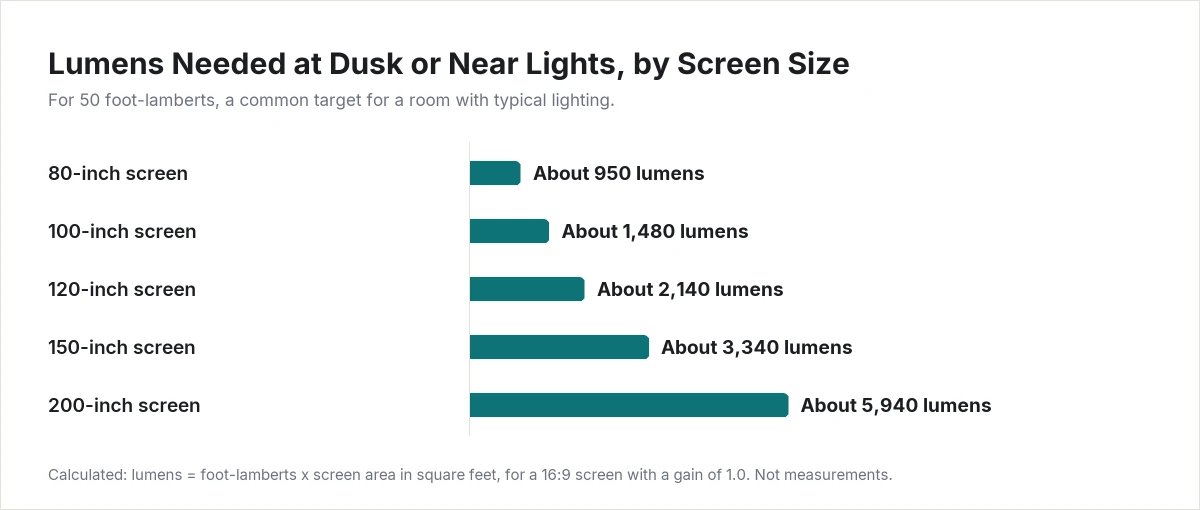
ProjectorCentral’s guide notes that a common recommendation for a family room with typical lighting is 50 foot-lamberts, about three times the dark-room target. A yard at sunset or a patio with string lights and a neighbor’s floodlight is at least that bright.
| Screen size (16:9) | Lumens for 50 foot-lamberts |
|---|---|
| 80 inches | About 950 |
| 100 inches | About 1,480 |
| 120 inches | About 2,140 |
| 150 inches | About 3,340 |
| 200 inches | About 5,940 |
Calculated from the same formula for a screen with a gain of 1.0.
The familiar advice to buy 3,000 lumens fits one case: a screen of about 140 inches with some light still in the sky. For a 100-inch screen an hour after sunset, it is more than you need.
Why Daylight Is Out of Reach
The clearest way to see the problem is to compare the light the projector puts on the screen with the light the sky puts there. Light falling on a surface is measured in lux, and one lux equals one lumen per square meter.
A 100-inch screen has an area of about 2.76 square meters. A projector that delivers 3,000 lumens puts roughly 1,090 lux on that screen. Here is how that compares with typical outdoor light levels:
| Condition | Typical light level |
|---|---|
| Direct sunlight | 32,000 to 100,000 lux |
| Full daylight, not in direct sun | 10,000 to 25,000 lux |
| Overcast day | About 1,000 lux |
| Sunrise or sunset on a clear day | About 400 lux |
| Family living room | About 50 lux |
| End of civil twilight | About 3.4 lux |
| Full moon on a clear night | 0.05 to 0.3 lux |
Typical values, which vary with weather, season, and the direction the screen faces.
In full daylight, the sky delivers roughly 9 to 23 times more light than a 3,000-lumen projector adds to a 100-inch screen. The picture is still there, but black areas of the image can be no darker than the sunlit screen itself, so contrast collapses. Even an overcast day roughly matches the projector’s entire output.
At sunset on a clear day, the same projector is ahead of the ambient light by less than three to one. A 500-lumen portable projector, which puts about 180 lux on a 100-inch screen, is still behind it. This is a rough comparison, since a shaded or north-facing screen receives less light than open ground. It still explains why a picture that looks faint at sunset looks good half an hour later.
Projector makers’ own guides are more optimistic. BenQ, for example, suggests 500 to 1,000 lumens for shaded areas or dusk and at least 2,000 for early evening or partial shade. The same guide concedes that direct sunlight is a challenge for any projector and recommends finding shade.
Who should not buy a projector for daytime use: anyone who wants to watch afternoon sports on a patio or by a pool. A projector will disappoint at any price a household would consider. An outdoor-rated TV is the right tool for that job.
Rated Lumens Are Not Always Real Lumens
The tables above assume the projector actually delivers the stated lumens. Three things get in the way.
The unit on the box
ANSI lumens and ISO lumens (ISO 21118) are standardized measurements of the light a projector puts on the screen. Other labels are not equivalent. BenQ notes that a projector’s ANSI lumen value is usually only about 30% of the lumen value of its light source. A product page that quotes “light source lumens” or simply “lumens” with a very large number may describe a much dimmer projector than it appears.
Claims that did not hold up
Even figures labeled ANSI have been wrong. In 2023, after a complaint from Epson, XGIMI revised the brightness of four models. Its Horizon Pro 4K went from a claimed 2,200 ANSI lumens to 1,500 ISO lumens, according to ProjectorCentral. The same report says Epson had pursued about ten similar cases in five years. Treat brightness claims from unfamiliar brands with caution, and look for independent measurements where they exist.
Picture modes and age
ProjectorCentral’s guide points out that a projector may need its full power mode to reach the brightness you calculated, and that lamp brightness decreases with age. The brightest picture mode on many projectors also has less accurate color than the modes meant for movies.
For these reasons, we suggest treating the numbers in the tables as the minimum real output and shopping for about twice that in rated ANSI or ISO lumens. This is our own rule of thumb, not an industry standard.
How to Get a Better Picture Without More Lumens
- Start later. Civil twilight ends when the sun is 6 degrees below the horizon. The National Weather Service notes that during civil twilight artificial lighting is often not needed, which means there is still plenty of light to wash out a picture. Waiting until it ends makes more difference than any projector upgrade.
- Make the picture smaller. Going from 150 inches to 120 inches gives the same projector about 56% more brightness on screen.
- Block stray light. Turn off porch and landscape lights that shine on the screen, and place the screen with its back to the brightest part of the sky or the nearest streetlight.
- Use a real screen. The formula above includes screen gain. A screen with a gain above 1.0 sends more light back toward viewers seated in front of it, at the cost of a dimmer picture from the sides.
Final Thoughts
For a backyard movie that starts after dark, a 100 to 120-inch picture needs about 500 to 700 real lumens, and a 150-inch picture needs a little over 1,000. If you want to start at sunset or your yard has a lot of stray light, triple those figures. If you want to watch in daylight, a projector is the wrong purchase.
Whatever number you land on, compare projectors by ANSI or ISO lumens only, and leave headroom for the gap between the rating and what reaches the screen.
Browse more in our Projectors section.
Frequently Asked Questions
Is 3,000 lumens enough for an outdoor projector?
After dark, yes, for any screen size most backyards can fit. By the formula in this guide, 3,000 lumens is enough for cinema-level brightness on a screen larger than 200 inches. At sunset it covers about 140 inches. In daylight it is not enough at any size.
Can I use a 500-lumen portable projector outside?
Yes, once it is dark, on a screen of about 100 inches or smaller. Check that the figure is in ANSI or ISO lumens. It will look washed out before the end of twilight.
What is the difference between ANSI lumens and other lumens?
ANSI lumens and ISO lumens follow published standards for measuring the light that reaches the screen. Terms such as light source lumens describe light produced inside the projector before it passes through the optics, so the number is much higher for the same picture brightness.
Does a bigger screen need a brighter projector?
Yes. The required light rises with screen area, not with diagonal size. A 150-inch screen has 2.25 times the area of a 100-inch screen and needs 2.25 times the lumens for the same brightness.
When should an outdoor movie start?
For the best picture, after the end of civil twilight, when the sun is 6 degrees below the horizon. Weather services and most weather apps list this time for your location.
Sources
- A Simple Guide to Calculating Lumens (ProjectorCentral, M. David Stone)
- Foot-lambert, including SMPTE 196M screen luminance (Wikipedia)
- Lux, illuminance examples (Wikipedia)
- Definitions of twilight (National Weather Service)
- Epson settles with XGIMI on brightness specs (ProjectorCentral)
- Units of brightness for projectors (BenQ)
- Daylight projectors for outdoor use (BenQ)
- Extension cord safety tips (Electrical Safety Foundation International)