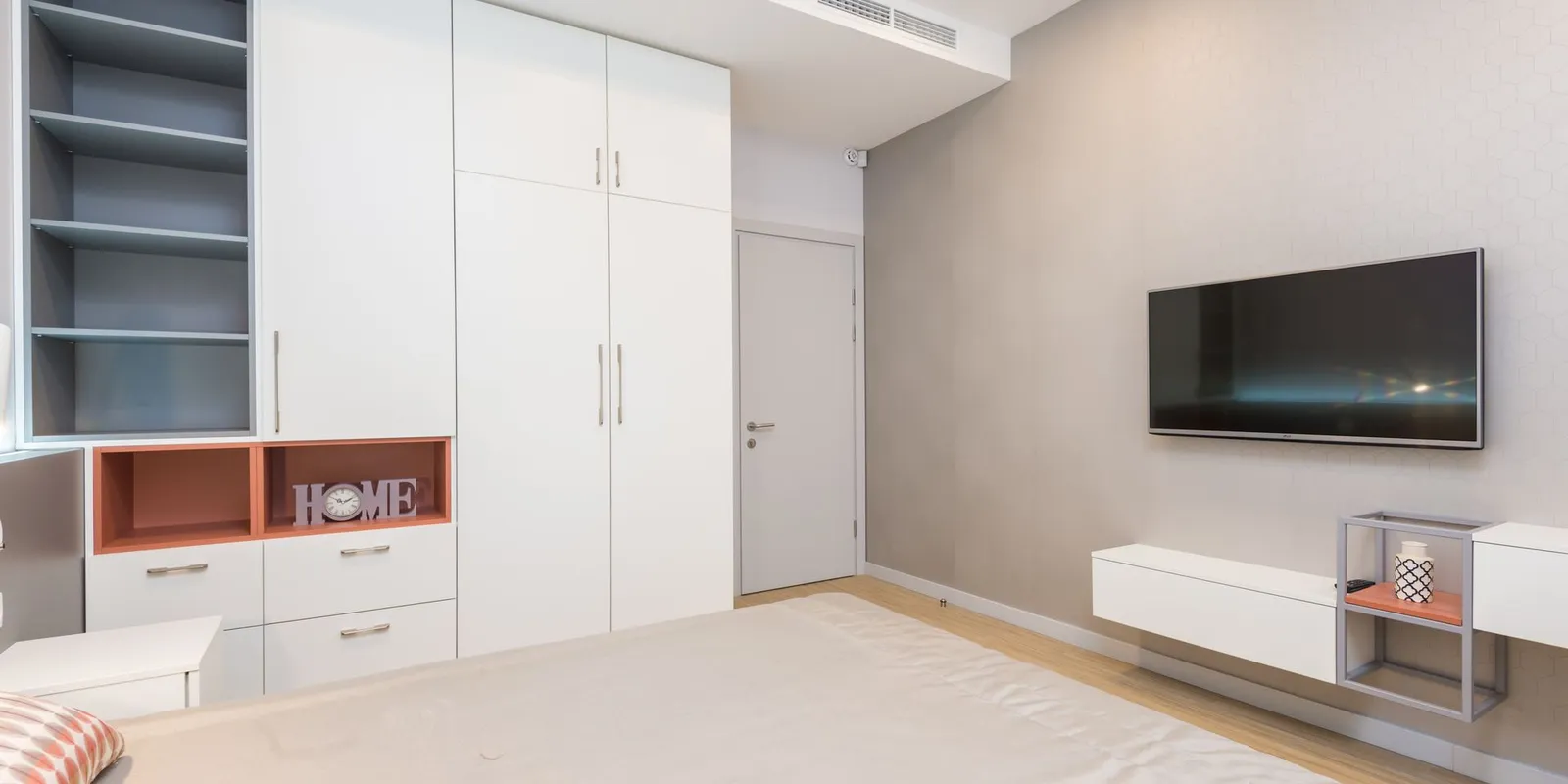
The usual advice for mounting a TV is to put the center of the screen at seated eye level, about 42 inches from the floor. That advice is written for a couch. In a bedroom you watch from a bed, often leaning back, and there is usually a dresser against the wall where the TV needs to go. Both push the right height upward.
This guide shows how to find the height for your own room in three measurements, and how much tilt you need once the TV sits above your eye line.
The Short Answer
- Most bedroom TVs end up with the center of the screen 50 to 60 inches from the floor. Mount maker Vogel’s cites about 60 inches as a common bedroom height.
- Your number depends on your eye height in bed and your distance from the wall. The farther away you are, the higher the TV can go while staying comfortable.
- Use a tilting mount. Once the screen is above eye level, tilting it down toward the bed keeps the picture facing you.
- Check the bottom edge. Make sure the TV clears the dresser and anything on it.
Safety First
Mounting a TV is a structural job, and a mistake can drop a heavy object in a room where people sleep. Read this section before you drill.
- Fasten the mount to studs or solid masonry. Use a stud finder. Mount maker Sanus notes that most studs are 16 or 24 inches apart and that steel studs need special hardware. If you cannot find solid framing where you want the TV, stop and ask the mount maker or a professional installer.
- Check the weight rating and VESA pattern. The mount must be rated for your TV’s weight and must match the hole pattern on the back of the TV.
- Look for safety certification. UL 2442 is the safety standard for wall and ceiling mounts. For TVs of 100 pounds or less, it requires a mount to hold at least four times its weight rating to earn certification.
- Do not run the TV’s power cord inside the wall. The National Electrical Code (section 400.12) does not permit flexible power cords to be concealed in walls. Use an in-wall power kit listed for that purpose, or have a licensed electrician add an outlet behind the TV.
- Check what is inside the wall. Wires and pipes often run near outlets and switches. If you are unsure, do not drill.
- Get help lifting. Hang the TV with a second person.
- Follow the instructions that come with your mount. They override any general guide, including this one.
If you rent, check your lease before drilling. If mounting is not an option, a TV on a dresser should be anchored so it cannot tip. The U.S. Consumer Product Safety Commission’s Anchor It! campaign covers how to anchor TVs and furniture, which matters most in homes with children.
Why the Living Room Rule Does Not Fit a Bedroom
Sanus describes 42 inches from the floor to the center of the screen as the optimal height, based on eye level for someone sitting on a couch. Three things are different in a bedroom.
You lean back. Propped against pillows or a headboard, your natural line of sight points slightly upward, not straight ahead. A screen placed above eye level sits where you are already looking.
The wall is often farther away. The TV usually goes on the wall past the foot of the bed. At a longer distance, the same height above eye level is a smaller angle.
There is furniture below. A dresser can be 30 to 40 inches tall on its own, so a 42-inch center height may put the bottom of the TV behind it.
Sanus’s own guidance for bedrooms is that the TV may need to go higher above a dresser or armoire, and that a tilting mount helps you get the right viewing angle.
Step 1: Measure Your Eye Height in Bed
Get into the position you actually watch from. If you sit up against the headboard, sit that way. If you lie back on two pillows, do that.
Have someone measure from the floor straight up to your eyes. Write the number down. This is your eye height. It varies with mattress height and posture, so measure it instead of guessing. If two people watch, use the lower of the two numbers or split the difference.
Step 2: Measure Your Distance to the Wall
Measure the horizontal distance from your eyes to the wall where the TV will hang. In most bedrooms this is the length of the bed plus the walking space at its foot.
Step 3: Pick How Far Above Eye Level to Go
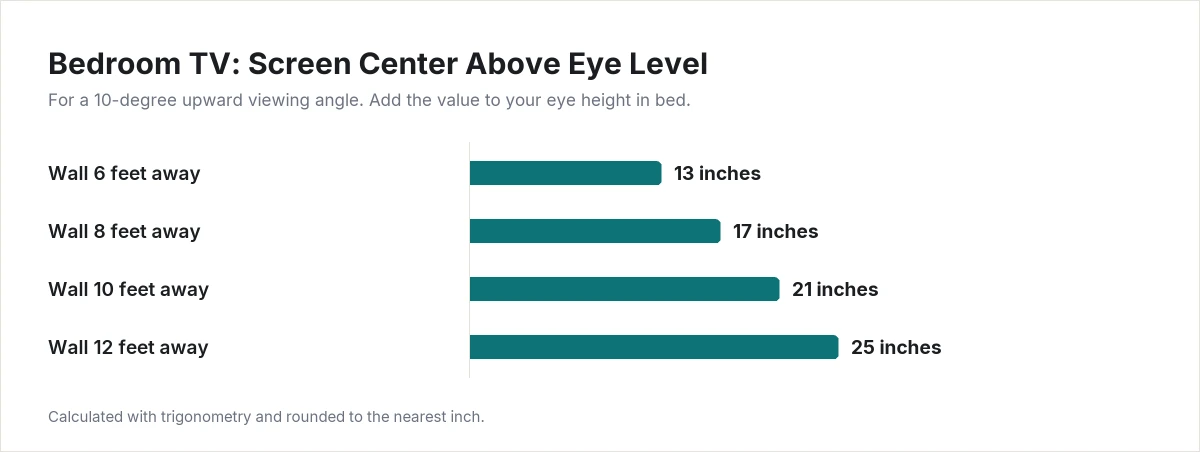
The table shows how many inches above your eye height the center of the screen sits for three upward viewing angles.
| Distance from eyes to wall | 5 degrees up | 10 degrees up | 15 degrees up |
|---|---|---|---|
| 6 feet | 6 in | 13 in | 19 in |
| 8 feet | 8 in | 17 in | 26 in |
| 10 feet | 11 in | 21 in | 32 in |
| 12 feet | 13 in | 25 in | 39 in |
Values are calculated with trigonometry and rounded to the nearest inch.
How to read it:
- 5 degrees suits people who sit nearly upright in bed.
- 10 degrees suits a typical leaned-back position against pillows.
- 15 degrees is the upper limit we suggest. Home theater design guidance attributed to CEDIA and SMPTE recommends that no viewer look up or down more than 15 degrees to the top or bottom of the screen. If you watch lying almost flat, you may prefer the TV near this limit, with more tilt.
Center height = your eye height + the number from the table.
A worked example
Suppose your eyes are 38 inches from the floor when you lean against the headboard, and the wall is 10 feet away. At 10 degrees, the table gives 21 inches. The center of the screen goes at 38 + 21 = 59 inches from the floor. That lands close to the 60 inches Vogel’s describes as common for bedrooms.
The example uses made-up measurements. Your own numbers will differ.
Step 4: Check That the TV Clears the Furniture
The center height is only half the answer. The bottom edge has to clear the dresser, and anything you keep on top of it.
Bottom edge = center height − half the height of the TV.
| Screen size (16:9) | Screen height | Half height |
|---|---|---|
| 43 inches | 21.1 in | 10.5 in |
| 50 inches | 24.5 in | 12.3 in |
| 55 inches | 27.0 in | 13.5 in |
| 65 inches | 31.9 in | 15.9 in |
| 75 inches | 36.8 in | 18.4 in |
Screen area only, calculated from the diagonal. The TV’s frame adds a little. Check your TV’s specifications for its exact height.
In the example above, a 55-inch TV centered at 59 inches has its bottom edge at about 45.5 inches. That clears a 36-inch dresser with room for a soundbar or a few items on top. If the bottom edge would sit behind your furniture, raise the TV and add tilt, or choose a different wall.
Step 5: Set the Tilt
When the screen is above eye level, tilt it down so it faces you. The tilt angle that points the center of the screen at your eyes is the same angle you chose in Step 3. In the example, that is about 10 degrees.
Tilt matters for two reasons. It keeps the picture square to your line of sight, and it helps picture quality on TVs with narrow viewing angles, where color and contrast shift when you view the screen from off center.
Before you buy a mount, check its tilt range in the specifications. A fixed mount has no tilt and only suits a TV at or near eye level. A full-motion mount adds swivel, which helps if the TV is off to one side of the bed.
Who Should Not Mount a TV High in a Bedroom
- Anyone who mostly watches sitting upright on the edge of the bed or in a chair. A lower TV near the 42-inch living room height will be more comfortable.
- Anyone whose wall has no usable studs where the TV needs to go. A TV stand or a dresser with an anchored TV is the safer choice.
- Renters whose lease does not allow drilling.
- Anyone considering a fixed mount for a high position. Without tilt, a high screen faces the opposite wall instead of the bed.
Final Thoughts
There is no single correct height for a bedroom TV. Measure your eye height in bed, measure the distance to the wall, and add the number from the table. For most bedrooms that puts the center of the screen between 50 and 60 inches from the floor, with the TV tilted down 5 to 15 degrees.
Then check the bottom edge against your furniture, fasten the mount to solid framing, and keep the power cord out of the wall.
Browse more in our Accessories section.
Frequently Asked Questions
Is 60 inches too high for a bedroom TV?
Not usually. Vogel’s cites about 60 inches to the center of the screen as a common bedroom height. Whether it suits you depends on your eye height in bed and your distance from the wall. At 10 feet, 60 inches is about 10 degrees above a 38-inch eye height.
Should a bedroom TV be tilted?
Yes, if the center of the screen is above your eye level. Tilt it down until the screen faces your usual viewing position.
How high should a TV be above a dresser?
High enough that the bottom edge clears the dresser and anything on it. Work out the center height from your eye level first, then subtract half the TV’s height to find the bottom edge.
Can I mount a TV on the wall above the bed’s headboard?
That puts the screen behind you, so it does not work for watching from bed. The TV belongs on the wall you face.
What is the standard TV mounting height?
Sanus gives 42 inches from the floor to the center of the screen, based on seated eye level on a couch. Bedrooms usually need more height because of the viewing position and the furniture below.
Sources
- How High Should I Mount My TV? (Sanus)
- How to Mount a TV: A Step-by-Step Guide (Sanus)
- The right TV wall height (Vogel’s)
- Home theater viewing angles, distances and sightlines (Acoustic Frontiers)
- How standards for wall and ceiling mounts help prevent serious injuries (UL Standards & Engagement)
- NEC 400.12, Uses Not Permitted (UpCodes)
- Anchor It! (U.S. Consumer Product Safety Commission)